
Streamlined Banking Services Examples in 2026
Streamlined Banking Services Examples in 2026 ! Decorative illustration framing article title Efficient banking, known in the industry as integrated financial services delivery, is defined as the consolidation of multiple financial products into a single, accessible platform that reduces friction for both individuals and businesses.
Efficient banking, known in the industry as integrated financial services delivery, is defined as the consolidation of multiple financial products into a single, accessible platform that reduces friction for both individuals and businesses. The best streamlined banking services examples in 2026 share three traits: unified access, automated processes, and embedded account management. U.S. Bank and Edward Jones, Apple Bank, ClearBank, and Grasshopper Bank each demonstrate how this model works in practice. For individuals managing checking, credit, and investments, and for business owners handling treasury and payroll, these examples show what efficient banking actually looks like when built correctly.
1. streamlined banking services examples for individuals
The clearest individual-facing example is the U.S. Bank and Edward Jones partnership, branded as Edward Jones Everyday Solutions. This platform integrates checking, credit cards, and investments with a single login, co-branded debit and credit cards, and mobile wallet access. Clients interact with one digital interface despite accessing products from two separate financial institutions.

The practical benefit is significant. Reducing the number of providers and logins improves client satisfaction by delivering an experience that feels like one provider. That perception matters because login fatigue and fragmented account views are among the top reasons individuals abandon digital banking relationships.
This model also reduces the mental load of financial management. Instead of logging into a brokerage account, a separate bank app, and a credit card portal, a user sees their full financial picture in one place. That consolidation is the defining feature of modern integrated banking for consumers.
- Co-branded debit and credit cards under one account relationship
- Mobile wallet integration for contactless payments
- Consolidated investment and banking dashboard
- Single login for all connected products
Pro Tip: When evaluating personal banking platforms, count how many separate logins you currently use. Any solution that reduces that number by half or more is worth serious consideration.
2. how business banking solutions simplify financial operations
Embedded banking is the primary model driving efficiency for business customers. ClearBank powers embedded accounts inside platforms like Tide, Shopify Balance, and Coinbase, providing bank licenses, regulated payment rails, and FSCS protection without requiring those platforms to hold a banking license themselves. Businesses using Shopify Balance, for example, access a fully functional bank account directly inside their commerce dashboard.
This model works because of a clear division of responsibility. The platform controls the user experience and onboarding flow, while the sponsor bank, in this case ClearBank, provides the regulated infrastructure. That separation of platform and bank maintains compliance without forcing the business user to interact with a traditional bank interface.
Grasshopper Bank takes a different approach for business treasury management. The bank launched an AI-driven treasury service using a robo-advisor called Waldo, integrated directly into its digital banking platform. Business clients manage their treasury portfolios from the same dashboard they use for daily banking, with no third-party portal required.
Embedded banking integrates regulated financial services directly into the tools businesses already use, eliminating the need to switch between platforms for core financial tasks.
- Tide: business accounts powered by ClearBank’s regulated infrastructure
- Shopify Balance: merchant banking embedded in the commerce platform
- Coinbase: crypto-adjacent banking with regulated account access
- Grasshopper Bank: AI treasury management within the existing business banking dashboard
3. how automation transformed customer onboarding
Apple Bank provides the most documented onboarding improvement in recent banking history. The bank reduced account opening time from 45–60 minutes to 5–10 minutes by deploying over 110 APIs for automated compliance checks and identity verification. That is not a minor improvement. It represents a fundamental redesign of how a customer enters the banking relationship.
The internal impact is equally important. Apple Bank reduced intervention rates from 80% to 30%, meaning far fewer applications required manual staff review. The bank now processes 800 applications monthly with the same staffing level it used before the automation was deployed. That is the operational definition of scaling without adding headcount.
Commerzbank approached the same problem through modular process design. Using Camunda for workflow orchestration, the bank built reusable onboarding components for KYC verification, customer number creation, and product-specific account setup. Each component works independently and can be recombined for different customer segments, personal or business, without rebuilding the entire flow from scratch.
Here is how these two approaches compare:
| Bank | Method | Time Saved | Key Metric |
|---|---|---|---|
| Apple Bank | 110+ API automation | 40–50 minutes per application | Intervention rate dropped from 80% to 30% |
| Commerzbank | Modular process orchestration via Camunda | Faster time to market per segment | Reusable KYC and onboarding components |
Pro Tip: When comparing digital banking platforms, ask specifically about their onboarding intervention rate. A low rate means fewer delays, fewer errors, and a faster path to using your account.
4. core features that separate leading platforms from traditional banks
The features that define leading examples of digital banking fall into five categories. Each one addresses a specific failure point in traditional banking.
Single-platform consolidation is the most visible feature. U.S. Bank and Edward Jones proved that clients feel more satisfied when they access multiple services through one interface. Traditional banks often require separate apps for checking, credit cards, and investment accounts, creating exactly the fragmentation that drives customers to look for alternatives.
Embedded account access removes the bank from the center of the user experience entirely. ClearBank’s model places the account inside the tool the customer already uses, whether that is a commerce platform or a crypto exchange. The banking infrastructure becomes invisible, which is the goal.
Automated compliance and identity verification directly affects how quickly a new customer can start using their account. Apple Bank’s use of over 110 APIs for automated checks is the benchmark. Manual compliance review is the single biggest bottleneck in traditional account opening, and automation is the only way to eliminate it at scale.
AI-driven advisory tools represent the next layer of value. Grasshopper Bank’s Waldo robo-advisor brings treasury investment guidance into the daily banking interface. That capability was previously available only through separate wealth management relationships, often with high minimum balances or advisory fees.
Modular process design is the operational backbone that makes all of the above possible at scale. Commerzbank’s use of reusable workflow components means the bank can launch a new onboarding flow for a new customer segment in days rather than months. That speed directly benefits customers because new products reach them faster.
5. choosing the right efficient banking solution for your needs
The right banking solution depends on what you are trying to fix. For individuals, the priority is usually reducing the number of accounts and apps required to manage daily finances. The U.S. Bank and Edward Jones model is the clearest example of what that looks like when done well.
For small business owners, embedded banking is the most practical path to efficiency. If your business already operates on Shopify, having a Shopify Balance account powered by ClearBank means your revenue, payments, and account management live in one place. You do not need a separate business banking relationship to handle basic treasury functions.
Advanced treasury management tools, like Grasshopper Bank’s AI service, come with eligibility requirements. Grasshopper’s treasury system requires a $250,000 minimum balance for access. That threshold reflects the risk management reality of offering investment-grade treasury tools within a banking platform. If your business does not meet that threshold, a simpler embedded banking solution is the more practical starting point.
- Individuals: Prioritize platforms with single-login access to checking, savings, credit, and investments
- Small businesses: Look for embedded banking options within platforms you already use for operations
- Growing businesses: Evaluate AI treasury tools once your cash reserves justify the eligibility requirements
- Budget-conscious users: Free or low-fee digital accounts with automated categorization deliver strong value without premium pricing
Pro Tip: Before switching banking platforms, map out every financial product you currently use and confirm your new platform can consolidate at least 70% of them. Integration capability is the metric that matters most.
Key takeaways
Efficient banking in 2026 is defined by consolidation, automation, and embedded access. The banks and platforms that deliver these three features consistently outperform traditional fragmented models on both customer satisfaction and operational efficiency.
| Point | Details |
|---|---|
| Consolidation drives satisfaction | Single-login platforms like Edward Jones Everyday Solutions reduce friction and improve client retention. |
| Automation scales onboarding | Apple Bank cut account opening from 60 minutes to 5–10 minutes using 110+ APIs. |
| Embedded banking fits business workflows | ClearBank powers accounts inside Tide, Shopify Balance, and Coinbase without requiring a separate bank app. |
| AI tools require eligibility thresholds | Grasshopper Bank’s treasury service requires a $250,000 minimum balance, reflecting risk controls. |
| Modular design accelerates delivery | Commerzbank’s reusable onboarding components reduce time to market for new customer segments. |
Rmous offers a connected banking ecosystem
Rmous is built on the same principles that define the best banking service practices in 2026: consolidated access, FDIC-insured security, and a financial ecosystem that works for both individuals and small businesses. Members access FDIC-insured checking and savings alongside loans, insurance, and the RMOPay™ instant transfer system, all within one membership. That means fewer accounts to manage, fewer apps to check, and one relationship that covers your core financial needs.
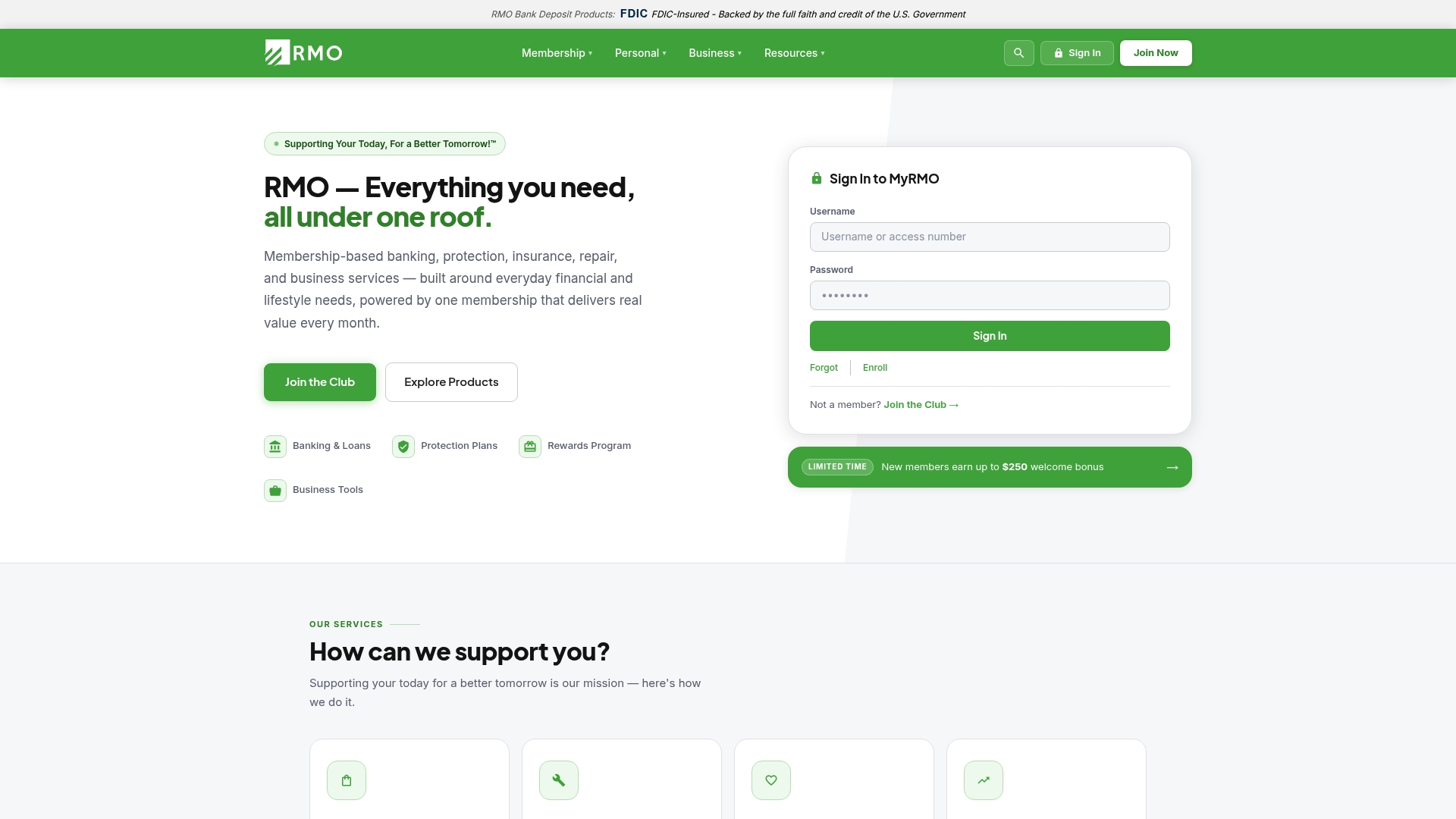
Rmous also supports small business members with products designed to reduce the operational complexity that comes with managing finances across multiple providers. The connected financial ecosystem at Rmous reflects what modern banking should deliver: real access, real savings, and a platform that grows with you. Explore what membership includes and see how Rmous compares to managing your finances across five separate providers.
FAQ
What are streamlined banking services?
Streamlined banking services are financial products and platforms that consolidate multiple accounts, tools, and processes into a single, accessible experience. Examples include the U.S. Bank and Edward Jones unified platform and ClearBank’s embedded banking model.
How does embedded banking work for businesses?
Embedded banking integrates regulated bank accounts directly into third-party platforms like Shopify or Tide. The platform manages the user experience while a licensed sponsor bank like ClearBank provides the underlying account infrastructure and payment rails.
How much faster is automated account opening?
Apple Bank reduced account opening from 45–60 minutes to 5–10 minutes using over 110 APIs for automated compliance and identity verification. Intervention rates also dropped from 80% to 30%, meaning fewer applications required manual review.
Do AI treasury tools require a minimum balance?
Yes. Grasshopper Bank’s AI-powered treasury service, built with robo-advisor Waldo, requires a $250,000 minimum balance for access. This threshold reflects the risk controls banks apply to investment-grade treasury management tools.
How do i improve banking efficiency as a small business owner?
Start by identifying which platforms you already use for operations and check whether they offer embedded banking. Shopify Balance is one example where business banking integrates directly into an existing commerce workflow, eliminating the need for a separate bank account relationship.